

The last time ICANN opened applications for new generic top-level domains, it was 2012. What came through the other side was over 1,200 new extensions, from .app, to .shop, .london, and .google, and a fundamental shift in how organisations could present themselves online. Then the window closed, leaving us with the same selection of TLDs for over a decade.
Well, it’s opening again.
The 2026 New gTLD Program is the first major expansion of the domain name system in more than a decade. Applications open on 30 April 2026 and run for 105 days. In that window, any eligible legal entity can apply for its own top-level domain: a branded TLD, a geographic extension, a community string, or an entirely new generic domain suffix.
The ICANN 2026 New gTLD Applicant Guidebook, all 440 pages of it, sets out exactly what that takes. This guide covers the most important parts: who can apply, what it costs, how the process works, and what organisations of all kinds need to do now to be ready.
What Is the ICANN New gTLD Program?
ICANN, the Internet Corporation for Assigned Names and Numbers, is the body responsible for coordinating the global domain name system. For most of the internet’s history, the top-level domain space was small: country codes like .uk and .de, plus a limited set of generic options including .com, .net, and .org.
The New gTLD Program changed that. Launched in 2012, it allowed organisations to apply for entirely new generic top-level domains: custom domain name extensions that didn’t exist before. The result was a wave of new domain suffixes: branded TLDs like .google and .bmw, community extensions like .nyc and .london, and industry-specific strings like .wiki, .shop, and .finance.
The 2026 Round, sometimes referred to as the ICANN next round, is the programme’s second iteration. It is a more structured, more transparent version of what came before, with clearer rules, stronger applicant support, and better mechanisms for managing contention between different applicants.
For organisations that missed the 2012 Round, or simply weren’t ready, this is the next chance. And for those exploring new domain extension opportunities for the first time, it’s worth understanding what the programme actually involves.
Why ICANN Is Launching the New gTLD Round
The case for a second round isn’t hard to make. The .Brand TLDs like .barclays and .bmw give organisations complete control over their digital namespace. Community extensions, such as .church or .wiki serve constituencies that .com and .org were never designed to reach. While geographic TLD extensions give cities and regions a distinctive, permanent presence in the global DNS.
But the 2012 Round also revealed gaps. Private contention resolution, where competing applicants settled string (which is what the proposed TLD names are called) disputes through their own arrangements, created problems the community wanted addressed. The Applicant Support Programme was limited. Internationalised Domain Names (IDN) coverage for domains in non-roman script was uneven. And the process was genuinely new, which built unpredictability into every stage.
The 2026 Round addresses all of this directly. It introduces a stronger Applicant Support Programme, a dedicated Registered Service Partner (RSP) Evaluation system that separates technical assessment from the application itself, a Replacement String mechanism to reduce contention before it starts, and an explicit ban on private contention resolution. It expands Internationalised Domain Name (IDN) coverage with Label Generation Rules for 27 different written scripts. And it provides a Predictability Framework for managing unexpected implementation issues.
Most importantly, it has been 14 years since the last round, during which the adoption and use of the Internet has exploded. So, now’s the time to get the next round of new gTLDs.
New gTLD Round Requirements: Who Can Apply
Not everyone can apply. And not every application will be approved. Here is what the Applicant Guidebook requires across financial, technical, and legal dimensions.
Financial Requirements
The base evaluation fee is USD 227,000 per application. That covers one primary gTLD string and up to four variant strings, along with all mandatory evaluation stages. It is a significant number, but it’s also the floor, not the ceiling.
Conditional fees apply depending on your application type. Community Priority Evaluation costs up to USD 80,000. A .Brand eligibility evaluation adds USD 500. Geographic Names Review can add up to USD 12,000. These stack on top of the base fee, and they don’t include legal counsel, internal resource allocation, or ongoing registry operational costs post-delegation.
For organisations that can’t absorb those costs, the Applicant Support Programme provides a path in. Qualified ASP applicants receive a 75-85% reduction on the evaluation fee, bringing the base as low as USD 34,050. The programme also includes training, access to pro bono service providers, applicant counsellors, and bid credits for ICANN auctions. The discount applies to conditional fees too. It’s a meaningful improvement over the ASP in 2012, though qualifying is its own process.
Payment is accepted by wire transfer, ACH, or SWIFT only. No credit cards, no cheques.
Technical and Operational Requirements: RSP Evaluation
The 2026 Round introduces a dedicated Registry Service Provider Evaluation Programme. In previous rounds, each application carried its own technical assessment. Now, RSPs (the organisations that provide the backend infrastructure to run a TLD, such as CentralNic Registry) are evaluated once and can then support multiple applications.
This matters considerably for applicants. Rather than assembling and proving a technical stack from scratch, organisations working with a pre-evaluated RSP can point to that provider’s existing approval. It reduces cost, evaluation complexity, and risks.
The RSP evaluation covers the full technical and operational picture: DNSSEC implementation, SLA compliance, security requirements, abuse response, data escrow, DNS performance, and ongoing reporting obligations. These are not light requirements. Registry operators take on binding contractual obligations that persist for the lifetime of the TLD.
Legal and Policy Compliance: Background Screening and Eligibility
Only legal entities may apply. Corporations, organisations, institutions, governmental bodies, and inter-governmental entities are all eligible. Individuals and sole proprietorships are not. Entities that are not yet legally formed, pending joint ventures, for example, will also not be accepted.
All applicants must demonstrate a genuine, good faith intent to operate the TLD. As part of the ICANN application process, submissions are made electronically via ICANN’s TLD Application Management System (TAMS), which requires multi-factor authentication on the applicant’s ICANN account.
Background screening covers the applying entity along with its directors, officers, partners, and any shareholders holding 10% or more equity. The criteria include criminal history, sanctions checks, history of cybersquatting, deceptive conduct, and prior violations of ICANN agreements.
One explicit exclusion worth noting: closed generics. Applications where a single entity seeks exclusive control of a generic descriptive string, like .tree or .bank, but used only by the applicant, will not be approved. This closes an ambiguity that caused significant debate in 2012.
If you have any questions about whether you are able to apply for a new gTLD, get in contact with us, and we’ll work it out with you.
New gTLD Program 2026 Timeline
The ICANN new gTLD program 2026 timeline is defined and, in most stages, fixed. Understanding the full sequence is essential for planning, both for the application itself and for internal approval processes that may take longer than expected.
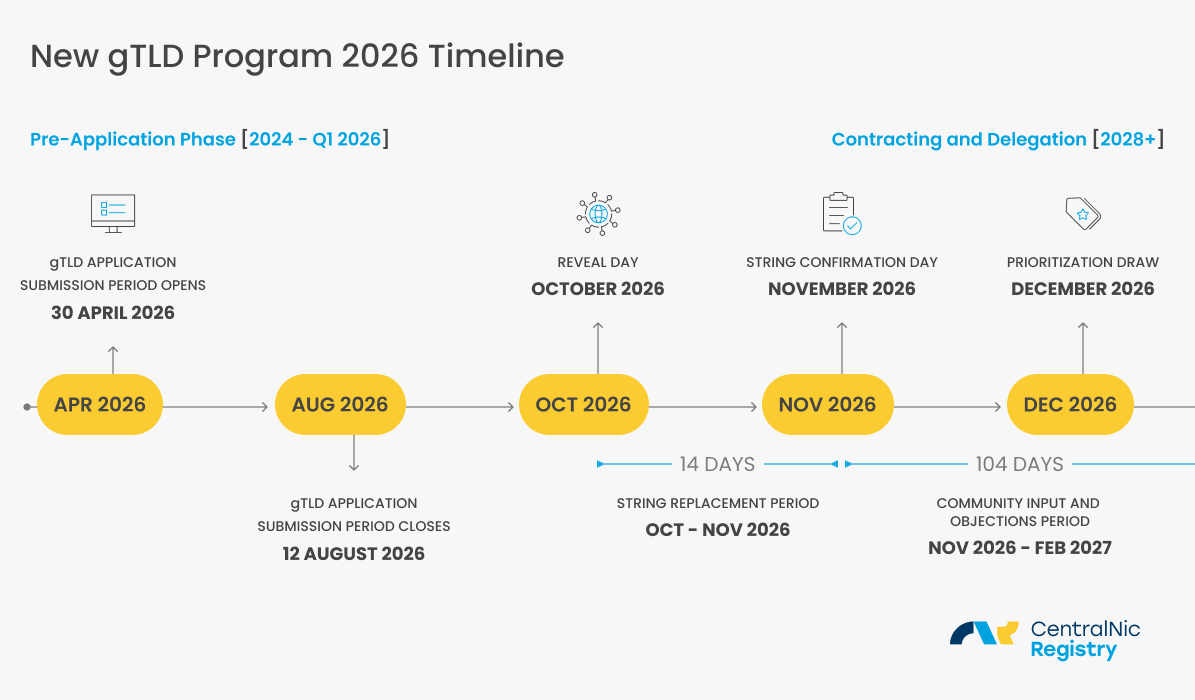
Pre-Application Phase (2024 – Q1 2026)
A lot of preparatory groundwork has been done well before the application window openning. ICANN established the policy framework, published the Applicant Guidebook (adopted by the ICANN Board on 30 October 2025), and made the Applicant Support Programme accessible.
New gTLD Application Submission Window (30 April – 12 August 2026)
The application window opens on 30 April 2026 and runs for 105 days, closing on 12 August. This is the time that anyone eligible can submit their applications. Applicants need to complete and submit three sections – Organisation Information, Financial Information, and gTLD Application Information – via TAMS (the TLD Application Management System, designed for this purpose). The evaluation fee must also be paid within seven days of the window closing.
Reveal Day, Replacement Period, and String Confirmation Day
Approximately two months after the application window closes, ICANN publishes a public list of all TLDs and their applicants that passed the initial checks. This is called Reveal Day. It’s here that initial contention sets for identical string applications are published (in other words, when two or more applicants have submitted for the same new gTLD). Importantly, from this point one, certain communications between competing applicants are restricted.
Reveal Day kicks off a 14-day Replacement Period. This is new for 2026. Applicants who submitted a replacement string alongside their primary choice, a backup TLD to fall back on if their primary is contested, can choose to swap to it during this window. Hopefully this reduces head-to-head contention before formal evaluation begins.
After the Replacement Period, String Confirmation Day finalises the final strings. The community input, objection, and evaluation phases then open.
String Evaluation and Name Collision Assessment (up to 180 Days)
String evaluation is where the proposed names are run through a series of potential fail states. These cover similarity checks against existing TLDs and other applications, name collision initial assessments, safeguard assessments, geographic name identification, and singular/plural notifications. Name collision assessment (examining whether a proposed TLD string could cause confusion with strings in use on private networks) is very involved, and make the assessment take much longer.
Objections and GAC Early Warnings (104 Days + 30 Days for String Confusion)
Four formal grounds for objection exist: String Confusion, Legal Rights, Limited Public Interest, and Community. Any eligible party can file a String Confusion objection within 104 days of String Confirmation Day. The objection process runs in parallel with evaluation, not after it.
The Governmental Advisory Committee (GAC) can also issue Early Warnings and Consensus Advice on specific applications. GAC Consensus Advice carries significant weight with the ICANN Board. If the Board issues it against an application, the applicant may need to withdraw or submit a formal Application Change Request.
Community Priority Evaluation (CPE) and ICANN Auction
Where multiple applications exist for the same or similar strings, resolution follows a defined path. Community applicants can elect Community Priority Evaluation, an assessment against four criteria: Community Establishment, Nexus, Registration Policies, and Community Endorsement.
If contention remains unresolved after all other mechanisms, ICANN runs an ascending clock auction as a last resort. ASP applicants receive bid credits for these auctions. And critically: private resolution of contention, including private auctions between competing applicants, is now explicitly prohibited. Violations can result in disqualification.
Contracting and Delegation (2028+)
Successful applicants receive an invitation to execute a Registry Agreement with ICANN, which they have 90 days from that invitation to sign. Then, once contracted, the TLD must be delegated within one year. Based on ICANN’s projections for approximately 2,000 applications received, programme completion is estimated around June 2030.
Types of gTLDs You Can Apply for in the New gTLD Round
The Applicant Guidebook defines several distinct application types, each with its own requirements, processing paths, and contractual implications.
.Brand TLDs
The .Brand TLD applications are for organisations applying for a TLD that matches their brand name, where only the registry operator, its affiliates, or trademark licensees will be registrants. Think .canon, .datsun, or .barclays. They operate under Specification 13 of the Base Registry Agreement, carry a USD 500 conditional eligibility evaluation fee, and are explicitly exempt from the closed generics prohibition.
.Brand applicants in contention have access to a .Brand String Change Request, which allows them to change their applied-for string to avoid contention resolution entirely. It is one of the more pragmatic tools in the programme, and one that doesn’t exist for other application types.
For large organisations evaluating how to apply for a new gTLD, the .Brand path offers the most control and the clearest eligibility route.
Geographic TLDs (GeoTLDs)
Geographic TLD extensions cover strings representing geographic names, like cities, regions, and territories. They require documented government or public authority support or non-objection, and are subject to a Geographic Names Review costing up to USD 12,000. Country and territory names at the top level are not available under the 2026 Round.
Community TLDs
Community TLDs serve clearly delineated groups such as professional associations, cultural organisations, religious communities, and similar. They can elect Community Priority Evaluation in contention, and operate under Specification 12, which requires Community Registration Policies. The conditional fees are higher, but the CPE path provides a route to priority that no other application type can access.
Internationalized Domain Names (IDNs) and Variant Strings
IDN applications for TLDs in non-ASCII scripts receive priority processing under the 2026 programme. Label Generation Rules are now available for 27 scripts, which is bug step up from 2012. For existing 2012 Round registry operators, up to four variant strings of their existing gTLD are fee-waived as a one-time exception.
Generic TLDs
Generic TLDs are open strings not tied to a specific brand, geography, or community. They’re entirely new domain suffixes. These are standard applications with no additional contractual specifications. They may face higher contention from competing applicants, but that’s because the commercial upside for new gTLDs that gain traction can be huge.
5 Strategic Benefits of Participating in the New gTLD Program
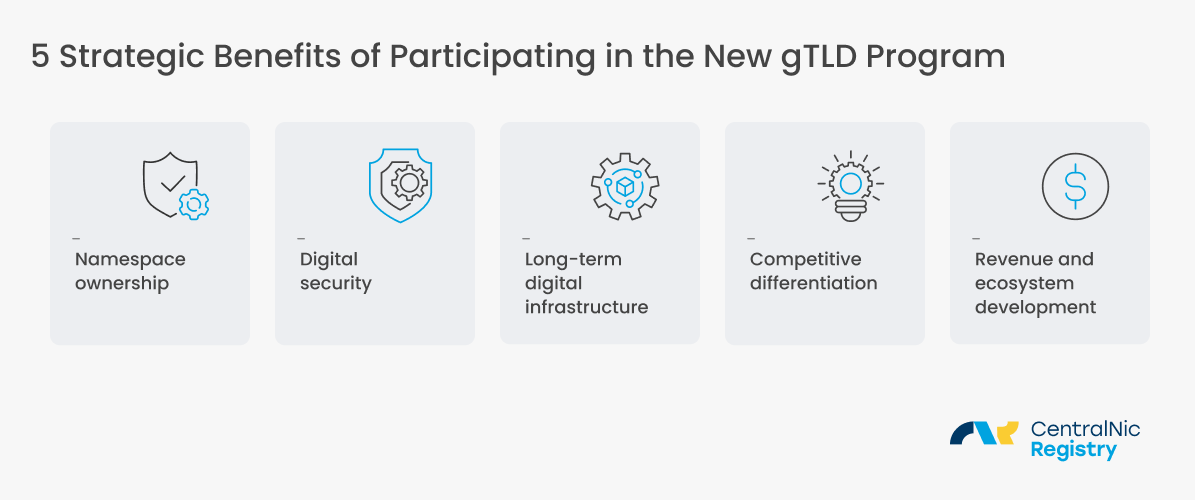
Namespace ownership. A TLD gives an organisation complete control over every domain registered beneath it. Brands secure a namespace competitors cannot touch. Geographic communities lock in a digital identity that is entirely theirs. That is not possible with any other domain registration model.
Digital security. .Brand operators determine who registers under their TLD. That eliminates the primary attack surface for phishing domains, lookalike fraud, and brand impersonation. All of these are threats that can cause real commercial damage to organisations managing large domain portfolios under shared registries.
Long-term digital infrastructure. A TLD is a long-term asset, not a campaign. Its value compounds over time, and it can simplify digital architecture significantly for large organisations managing complex sets of global domain name extensions.
Competitive differentiation. The window for securing distinctive, valuable strings is finite and competitive. Organisations that move in the 2026 Round lock out future competition. Once you’ve got a TLD, its yours.
Revenue and ecosystem development. For generic and community TLD operators, there is a commercial dimension. Registry businesses are built on domain registrations, and if you a new gTLD takes off, that’s a big and continuing win for them.
Key Risks to Navigate in the New gTLD Round
If you’ve read this far, you realise that the application process is multi-staged, technically demanding, and expensive enough that missteps hurt.
String contention is the most common immediate risk. If another entity applies for the same or a confusingly similar name, both applications enter a contention set, and resolution takes time and money, with no guarantee you’ll get the name either. The Replacement String mechanism is the primary way to reduce this risk, which is why string strategy and the choice of a replacement string matter more than they might appear.
Evaluation failure can occur at multiple points. Background screening, financial review, RSP assessment, and .Brand eligibility evaluation are all checkpoints where applications can stall. Incomplete documentation or ambiguous corporate structures are among the most common causes. Save yourself the cost of restarting by making sure you are fully prepared.
Ongoing compliance obligations are consistently underestimated. Registry operators take on binding contractual commitments under the Registry Agreement: DNSSEC maintenance, SLA reporting, data escrow, abuse response, and ICANN audit obligations. These are not one-time requirements. They persist for the life of the TLD, and they require operational infrastructure that many applicants simply don’t have in-house. Which is where experienced RSPs are key.
GAC intervention is a real risk for applications touching on government-sensitive areas. That means geographic names, names close to healthcare or financial services, or anything that might draw objection from a national government. Early research into potential GAC sensitivities, and where possible engaging with them before you submit, can do a lot to reduce your risk.
Timeline risk is often underestimated. The New gTLD Application Window is 105 days, but assembling a complete application takes substantially longer than it looks from the outside. Organisations that begin serious preparation after the window opens are already behind.
How to Prepare for the New gTLD Round: Step-by-Step Guide
Make like an ambitious endeavour, when it comes to getting a new gTLD, preparation is key. There’s a lot of information to collect, documents to cover, stakeholders to include and finances to prepare. Here’s what to do:
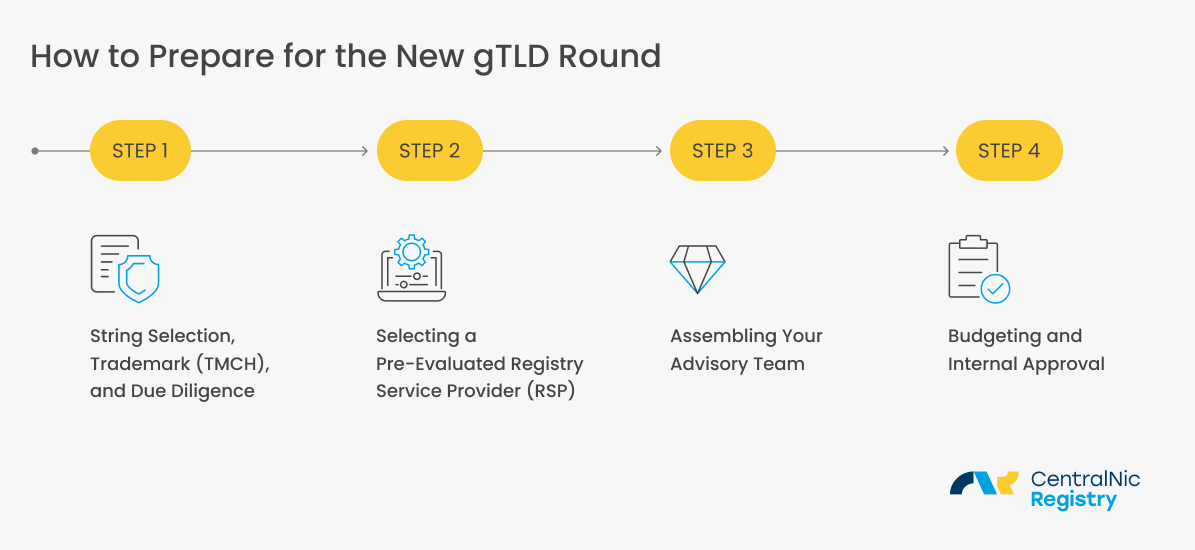
Step 1: String Selection, Trademark (TMCH), and Due Diligence
Choose your primary string and define a replacement string as a fallback. Both should be checked against ICANN’s Blocked Names and Reserved Names lists via TAMS before you commit. If your application is a .Brand, engage with the Trademark Clearinghouse to confirm your trademark position before submitting. The TMCH is an existing ICANN service that maintains a database of verified trademarks, and engaging with them before application strengthens your eligibility case.
String selection is vital. And of course it is, it is the TLD you’re investing in. Everything downstream, evaluation, contention risk, the brand or community story you’re telling, depends on choosing and protecting the right one. It is worth investing proper time here.
Step 2: Selecting a Pre-Evaluated Registry Service Provider (RSP)
An RSP provides the technical backbone of your TLD for you. They are there to handle the DNS infrastructure, DNSSEC, SLA-compliant operations, data escrow, abuse handling, and ongoing compliance management. Working with a pre-evaluated RSP removes the technical evaluation burden from your own application and substantially reduces risk at that stage.
CentralNic Registry is a pre-evaluated RSP for the 2026 Round, and has been operating domain registry services for over 25 years, supporting hundreds of TLDs across brand, geographic, community, and generic categories. If you are evaluating RSP options, that operational track record across every ICANN programme cycle is directly relevant to what you are about to navigate.
Step 3: Assembling Your Advisory Team
The Applicant Guidebook runs to 440 pages for a reason. Experienced legal counsel familiar with ICANN processes, a financial adviser who understands the full cost structure, and an ICANN programme consultant who has navigated these evaluation stages before are all worth the investment. The stakes are high enough that gaps in expertise will eventually show up as costs that need to be paid. One misread policy requirement or missed deadline can stall an entire application.
Step 4: Budgeting and Internal Approval
Understanding the true cost of launching a TLD means planning beyond the headline USD 227,000 base evaluation fee. All the additional costs, from conditional evaluation fees to legal costs, internal resource allocation, and post-delegation operational expenses all add to the real total. If you need to follow internal approval processes, such as boards or procurement committees, need the full picture assembled and signed off before the window opens.
How CentralNic Registry Can Help You Succeed in the New gTLD Round
CentralNic Registry has been there for every significant ICANN programme cycle since the domain industry began scaling. We operate registry infrastructure for 46% of all existing new gTLDs, including hundreds of active TLDs across branded TLD domains, geographic extensions, community strings, and generic domain suffixes. That translates to over 30 million new gTLD domains serving over a billion queries every day.
Our infrastructure meets every ICANN compliance requirement, and our operations team has a long history of navigating the post-delegation obligations that come with managing live TLDs at scale.
We are a pre-evaluated RSP under the 2026 RSP Evaluation Programme for Main, DNS and DNSSEC services. Applicants working with us won’t have to carry the technical evaluation overhead in their own applications. And that will be a significant operational and financial advantage for you at an already complex stage in the application process.
But more than the infrastructure, our team is here to give strategic guidance at every stage of the journey: from string strategy and contention risk analysis to application support, evaluation navigation, contracting, and long-term registry operations. We’ve done this before, for dozens of gTLDs that are out in the world today, and we can do for your organisation.
The 2026 ICANN New gTLD Program represents the best opportunity in more than a decade to secure a new top-level domain. With the right registry partner, the path from application to delegation is considerably more manageable than the 440-page guidebook might suggest.
Frequently Asked Questions
How much does it cost to apply for a new gTLD in 2026?
The base evaluation fee is USD 227,000 per application, covering one primary string and up to four variant strings. Conditional fees apply on top: up to USD 80,000 for Community Priority Evaluation, USD 500 for .Brand eligibility evaluation, and up to USD 12,000 for Geographic Names Review. Qualified Applicant Support Programme applicants can receive a 75-85% reduction, bringing the base fee as low as USD 34,050. Costs also include legal, operational, and advisory fees beyond the ICANN evaluation charges.
Is there an Applicant Support Programme in the New gTLD Round?
Yes. The ASP for the 2026 Round is significantly expanded from 2012. Qualifying organisations, typically those from developing economies or with demonstrably limited resources, receive discounted evaluation fees, access to training and pro bono service providers, dedicated applicant counsellors, and bid credits for ICANN auctions. The discount applies to both the base evaluation fee and conditional fees.
When will the first new gTLDs from this round go live?
Based on ICANN’s projections, contracting and delegation for successful applicants is expected to begin in 2028, with the final programme completion estimated around June 2030. This is based on an expected 2,000 applications. The more applications submitted overall, the longer the processing timeline extends.
What happens if two companies apply for the same string?
They are placed into a contention set. Resolution options include using the Replacement Period to switch to a pre-selected backup string, Community Priority Evaluation for qualifying community applicants, and, as a final resort, an ICANN ascending clock auction. Private resolution of contention between competing applicants is explicitly prohibited in the 2026 Round, with violations risking disqualification.
Can I change my applied-for string after submission?
Not freely. Application Change Requests are only available after String Confirmation Day. .Brand applicants have a specific mechanism (the .Brand String Change Request) that allows a string change to avoid contention resolution. Outside of that, changes are restricted and subject to fresh community input and string evaluation. Applicants who submitted a replacement string during the application window can swap to it during the 14-day Replacement Period.
What are Blocked and Reserved Names?
Blocked Names are strings that cannot be applied for, typically for technical stability or policy reasons. Reserved Names are specific strings withheld from second-level registration within an approved TLD. Both lists are available for review via TAMS before submission, and checking against them early is a basic step in any string selection process.
What is the Prioritisation Draw?
If the volume of applications requires it, a prioritisation draw determines the processing order for applications at certain evaluation stages. It is a randomised ordering mechanism, not a competitive assessment, but the order it produces affects timing, which has downstream implications for contention resolution, contracting timelines, and ultimately delegation dates.


